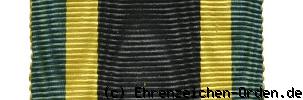
German Awards - Common Badge of Honour in Silver For Merit
The general badge of honor was established on June 25, 1902 by the Grand Duke Wilhelm Ernst of Saxony Weimar. The purpose of the award was to recognize excellent merit, especially many years of exemplary performance of duty and faithful work. Or in favor of the ruling house. Different inscriptions on the reverse were provided for Weimar subjects. For general merits "For Merit," for many years of activity "For Faithful Service" or many years of work "For Faithful Work." Citizens of other states could also receive a badge of honor with the code "W-E." Mostly subordinate officials and employees and less significant honorary performers were awarded. A prerequisite for rewarding for many years of activity was considered 30 years of public service in the Grand Duchy or the same seigneur. The general badge of honor was awarded in three classes of gold (silver gilded), silver and bronze. Along with seniority, the social position of a person is the determining factor. The silver badge of honor depicted here was reserved for middle officials and servants. The gold badge of honor was to be awarded only for exceptional, outstanding services or especially a long and devoted service life. The Stempelschneider was Arthur Krueger, a sculptor and medallist who had owned the Berlin Coin Medal since 1895. The exact dates of the award are unknown to me. Source: J. Nimmergut, Deutsche Orden und Ehrenzeichen bis 1945, vol. III, 1999.
Round silver medal with raised border. On top is a soldered eye with a ribbon ring. On the rim next to the eye is a silver stamp - SILVER 990 -.
Front side:
In the - center of the picture is a portrait of Grand Duke Wilhelm Ernst.
- On the margins is the inscription: - WILHELM - ERNST - GRAND DUKE - VON - SAXONY -.
- Under the neck section of the die cutter - A. KRUGER F. -.
Downside:
A - dense wreath of oak leaves is tied crosswise along the edge above and below.
- In the included field there are two lines - DEM -/- MERIT -.
Tape:
- Width 39 mm, side stripes green/yellow 5 mm each, central stripes black 19 mm.
.
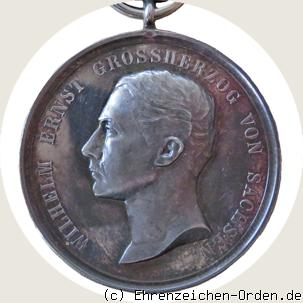 Obverse: Common Badge of Honour in Silver For Merit
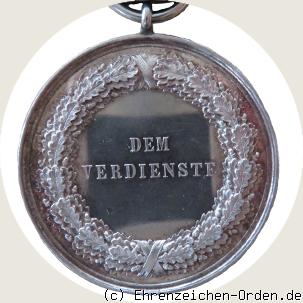 Reverse: Common Badge of Honour in Silver for Merit
Established:
June 25, 1902 Grand Duke Wilhelm Ernst
Data:
- Material: Silver
- Size: 36mm
- Weight: 24.4g
estimated collector price:
190 – 200 €

 Awards of World War II